
Food trucks have captured the imaginations and appetites of consumers everywhere, yet the allure of franchising this mobile culinary experience faces considerable challenges. Regulatory restrictions, the inherent mobility of food trucks, brand consistency issues, operational complexities, and shifting consumer preferences all conspire to complicate franchising efforts in this vibrant industry. This article delves into these aspects, dissecting why food trucks often don’t successfully franchise despite the opportunities they bring to the table. Each chapter will unpack these critical elements, revealing the deep-seated reasons behind the struggles in food truck franchising, serving as a guide for car enthusiasts and potential entrepreneurs alike.
Permit Paralysis: How Fragmented Regulations Prevent Food Trucks from Franchising
Permit Paralysis: How Fragmented Regulations Prevent Food Trucks from Franchising
Mobile food businesses promise agility, low overhead, and rapid market testing. Yet the regulatory environment often neutralizes those advantages. In places where legal frameworks for mobile vendors are unclear, franchising becomes infeasible. Franchises require repeatability, enforceable standards, and predictable compliance costs. Where permits, inspections, and zoning vary by district, those pillars crumble.
A fragmented licensing system creates immediate operational uncertainty. In many jurisdictions there is no single, nationwide path to register a mobile food unit. Rules that govern food premises, vehicular safety, and road transport are scattered across agencies. Agencies sometimes issue guidance that conflicts with local practice. Historical gaps in national direction left local governments to improvise. That improvisation produces a patchwork of municipal rules. Franchise models rely on consistency. When municipal discretion controls whether a truck can park or sell, consistency vanishes.
Unpredictability increases both true costs and perceived risk for franchisors and franchisees. Brands expanding through franchises must ensure that every unit meets health and safety standards. They need uniform operating procedures. They must guarantee menu quality and food handling. When a single city can revoke a permit for a technicality, the financial exposure for a franchisee grows. Potential investors weigh these risks. Many decline to commit capital when a license can be denied or altered on a local whim.
Transport and food-safety rules add layers of complexity. Recent regulatory trends show a tightening of oversight for mobile food operations. New rules that require special licensing to transport certain liquid foodstuffs illustrate this trend. While initially targeted at bulk edible oils and dairy, such measures signal how transport rules can encroach on mobile retail. If food trucks fall into the scope of these transport regulations, they face extra inspections, enhanced documentation, and vehicle-specific requirements. These demands increase capital needs and administrative work. They also create liability exposures tied to transport records and storage conditions.
Franchising amplifies these effects. The core of any franchise system is replicable compliance. Franchisors must disclose operational details and register under franchise laws. Those laws often include strict requirements. For instance, franchisors may need to prove a minimum operational history before offering franchises. They must file disclosures and follow registration rules with national authorities. Failing to meet those obligations can trigger heavy fines. When franchise units are mobile, meeting record-keeping tests becomes harder. Trucks move across jurisdictions. They may require different permits in each stop. Keeping documentation current and uniform strains administrative capacity.
Enforcement variance also undermines brand control. Compliance officers in different districts interpret rules differently. One city may insist on a fixed water-supply arrangement. Another may permit portable tanks. One district may limit operational hours. Another may allow extended service during festivals. This inconsistency forces franchisors to adopt either the most restrictive practices across their network or accept variability in customer experience. Either option is costly. Adopting the strictest requirements increases capital and operating expenses. Accepting variability damages the brand promise of a reliable customer experience.
Beyond regulatory text, practical enforcement actions create operational disruption. Citations, fines, or impounding of vehicles for minor infractions can halt revenue for days. For a brick-and-mortar franchise, a temporary closure is expensive but localized. For a mobile unit, impoundment is catastrophic. Trucks are specialized investments. Repairs, lost sales, and litigation add up quickly. Franchisees see this as risk concentrated in a single asset that is mobile and exposed. This perception discourages franchise uptake.
Supply chains and commissary requirements further complicate franchising. Many regions require mobile vendors to operate from licensed commissary kitchens for food prep and storage. These requirements aim to protect public health. They also create dependencies. A franchised truck network needs reliable access to approved commissaries across territories. Establishing or contracting with multiple commissaries raises operational costs. It also limits site selection flexibility, which is one of the main advantages of the mobile model. Centralized supply control is essential for brand consistency. But decentralized commissary access tends to produce inequality between units.
Insurance and liability considerations add another deterrent. Insurers price risk based on regulatory clarity and enforcement history. In markets with ambiguous rules, premiums rise. Lenders and investors similarly view regulatory ambiguity as a factor that increases default risk. Franchise agreements must therefore include more protective clauses. These clauses can deter potential franchisees or make franchise fees unattractive. The legal burden flows both ways: franchisors must police compliance, and franchisees must carry the operational risk.
Regulatory friction also affects recruitment and training. Franchises depend on standardized training programs and audits. When rules differ between jurisdictions, training must expand to include local requirements. This complexity increases onboarding time and costs. It also reduces the speed at which new units can open. Rapid scaling—a common franchise advantage—loses momentum when each new market requires a bespoke compliance plan.
Despite these obstacles, solutions exist that could make franchising viable. A nationally harmonized mobile-vendor category would reduce local discretion and create clearer standards. Standardized inspection protocols and a national licensing pathway would help franchisors ensure consistent compliance. Centralized digital record systems could track vehicle inspections, commissary visits, and transport documents across jurisdictions. Specialized transport exemptions, limited to retail mobile operations, could prevent heavy-handed rules aimed at bulk transport from applying to individual trucks.
In the absence of national uniformity, franchisors can still deploy mitigations. Robust compliance teams can map local rules before expansion. Franchise agreements can include explicit clauses allocating regulatory risk. Networks can build relationships with approved commissaries and pre-certified service providers. Investment in vehicle-standardization reduces maintenance variability. Finally, adopting strong traceability systems protects public health and demonstrates seriousness to regulators.
The regulatory environment, as it stands, does not merely inconvenience food trucks. It creates structural barriers to franchising. Unless policymakers establish clearer, harmonized rules and inspection regimes for mobile vendors, franchising will remain costly and risky. Brands will continue to prefer controlled, predictable storefront models. For mobile ventures to scale through franchising, law and administration must catch up with the operational realities of a mobile food system.
For operators seeking a practical primer on legal hurdles and startup compliance, see this discussion of legal considerations for Latino food truck startups: Legal considerations for Latino food truck startups.
More formal guidance on food business licensing and premises standards is available from the State Administration for Market Regulation: https://www.samr.gov.cn/xxgk/gzdt/sjxx/202502/t20250220_738982.html
The Mobility Paradox: How Tiny, Agile Vehicles Enable Market Testing While Complicating Food Truck Franchising
The debate around why food trucks don’t always become franchise powers often centers on location dynamics, branding, and capital costs. Yet a subtler force is reshaping the equation: minimobility. Small, nimble vehicles—microcars, electric scooters, compact delivery pods—promise to unlock new urban spaces, accelerate market testing, and slash upfront costs. They make it possible to seed a brand in multiple neighborhoods without the risk of locking into costly real estate or rigid fleets. But this very agility introduces a different set of complexities that can complicate the franchise strategy. If a system can pivot instantly in response to data, it can also drift away from a single, coherent brand experience. The tension between freedom of movement and the need for consistent, scalable operations is at the heart of why some food truck concepts resist rapid franchising even as they embrace minimobility as a growth engine.
The first advantage is cost efficiency, and it’s more nuanced than a simple cheaper vehicle. Minimobility vehicles require less capital and, critically, take up far less space. In dense urban corridors where space is a premium and parking is a legal labyrinth, the ability to park in a wider range of spots can dramatically improve revenue opportunities. A franchise model that relies on traditional trucks often faces the double burden of securing prime curb space and absorbing higher insurance and maintenance costs. When fleets are built around minimobility platforms, the initial hurdle to scaling down is not just the price tag of each vehicle but the operational footprint that comes with it. Every unit consumes less power, occupies less real estate, and can be shifted between neighborhoods with a speed and simplicity that a full-size truck cannot match. This makes rapid prototyping of markets more feasible and reduces the financial risk of exploring new territories, a capability many would assume would accelerate franchising rather than complicate it. Yet the same efficiency that lowers entry barriers also raises expectations for precision in execution across a growing network. If a system promises rapid expansion, it must translate that promise into a reproducible experience, regardless of which minimobile unit, driver, or neighborhood is involved.
Urban environments pose persistent, almost paralyzing challenges for brick-and-m mortar–adjacent concepts, and minimobility offers partial relief. The smaller form factor means the fleet can access neighborhoods where fixed-location trucks simply can’t operate, breaking through the traditional barrier of “not in my zone.” But with this mobility comes the need for sophisticated route planning, lifecycle management for batteries and electronics, and real-time scheduling that accounts for weather, street closures, and crowd dynamics at events. Franchise operators must therefore invest in a centralized software layer that tracks inventory, monitors vehicle health, and streamlines replenishment across geographies. This is where the advantages of data-driven decision-making become a double-edged sword: the same data that allows a franchisor to deploy a concept quickly in a new market can reveal inconsistencies in menu performance or service cadence across units. In a traditional franchise, you can bake in standards through a fixed kitchen-and-restaurant template. With minimobility, you bake standards into a digital, mobile template—the result is powerful but demands relentless discipline, because deviations in experience travel faster than ever when the brand is literally on wheels.
The regulatory landscape amplifies these tensions. Even as minimobility reduces some fixed-location constraints, many cities still regulate street vending with permits, hours, and zones that vary by block and season. A fleet of trucks can be shepherded into a handful of prime locations, but a fleet of minimobiles requires a different playbook: continuous permit renewals, dynamic location strategies, and rapid compliance monitoring. The flexibility to move from one district to another is a boon for market testing; it is also a reminder that the franchising blueprint must anticipate bureaucratic friction. A franchise system built around minimobility must integrate regulatory intelligence into its core operations. Standard operating procedures should include location scouting, permit management, and contingency plans for sudden restrictions, without compromising the consistency that consumers expect from a franchise brand. In this regard, minimobility cannot be an escape hatch from governance; it is a magnifier of governance, demanding clearer accountability, sharper training, and more robust risk management.
One of the most compelling aspects of minimobility is the way it enables rapid, low-risk market testing. Franchisers can deploy small, agile units to gauge demand in underserved neighborhoods, pilot new menus, adjust pricing, and test service models with fast feedback loops. The concept allows a brand to iterate in real time, something that traditional, fixed-location models struggle to emulate. This aligns neatly with the appetite of urban consumers for experiences, speed, and customization. A franchise network can learn which menus travel best, which neighborhood demographics respond to certain pricing strategies, and which service formats—self-serve kiosks, pickup windows, or curbside handoffs—resonate most in different micro-markets. The potential payoff is authenticity at scale: a brand that calibrates itself to local palettes without sacrificing its core identity. The challenge is to ensure that such local adaptation does not fracture the brand’s coherence. When every minimobile unit can pilot a distinct menu or interior experience, the risk of divergent customer expectations grows. In a franchising system, that divergence can erode what the parent brand stands for, unless there is a tight governance framework around menu architecture, branding cues, and experiential standards. The balance between local relevance and national consistency becomes a central strategic tension, and it often determines whether minimobility accelerates or merely fragments growth.
Data is the currency that powers this balance. The rapid ability to change routes, test locations, and monitor performance across fleets makes data-driven decision-making not optional but essential. With minimobility, a franchise can collect granular metrics on dwell times, queue lengths, visit frequency, and peak periods by street corner, block, or neighborhood. This information can illuminate patterns that inform where to deploy future units, how to staff efficiently, and what inventory to stock in shared kiosks or portable kitchens. Yet the data also imposes a heavier burden: it requires strong data governance, privacy protections, and analytics capabilities that can translate numbers into repeatable, scalable playbooks. In a franchising model, the challenge is to standardize analytics so that all units contribute to a coherent corporate picture rather than creating a patchwork of locally optimized but brand-diluting practices. This is where an effective minimobility strategy becomes a test of organizational maturity. The most successful networks will not only deploy nimble vehicles but will also invest in a centralized platform that coordinates supply chains, equipment maintenance, and marketing analytics with rigorous quality control. Without that backbone, the data becomes noise, and the promise of faster iteration collapses into inconsistent service and misaligned branding.
The customer experience in a minimobility-driven franchise is dynamic and multi-sensory. Urban diners often value speed, customization, and the perception that a brand understands their neighborhood. Minimobility can deliver on those expectations by enabling fast, localized menu adaptations and the ability to respond to festivals, pop-ups, or seasonal events. But speed can come at the cost of predictability. If a shopper in one block encounters a different menu, packaging, or even a different tone of service than a shopper three blocks away, brand equity weakens. The franchisor’s duty is to preserve the essence of the brand while granting micro-innovation space at the unit level. This requires a precise playbook: standardized visual language, core menu components designed for quick assembly, and training that emphasizes both consistency and situational judgment. The tension between uniformity and localization is less about the hardware—minimobility vehicles—and more about the software that runs the network: the training modules, the performance dashboards, and the escalation protocols that ensure a misstep in one market does not cascade into a broader reputation problem.
As this chapter on mobility and market testing unfolds, it becomes clear that the question of why food trucks don’t franchise easily is not about a simple mismatch of concept and capital. It is about a mismatch between the speed and fluidity of modern urban mobility and the slower, more deliberate cadence of brand governance. Minimobility offers a compelling path to growth by opening doors to neighborhoods once unreachable by traditional fleets. It invites experimentation, which is the lifeblood of a thriving, adaptive brand. Yet to convert this potential into a durable franchise, operators must design a system that can absorb rapid change while preserving a consistent, trusted customer experience. They must invest in centralized operations, robust maintenance infrastructures, and a data-driven culture that ties micro-level experimentation to macro-level strategy. They must also reconcile regulatory complexity with the desire to explore new frontiers. When done well, minimobility does not just make franchising possible; it redefines what franchising can be in an urban, post-pandemic economy. When done poorly, it risks turning expansion into a carnival of pilots with little staying power.
For readers curious about how this plays out in real urban contexts, consider how minimobility opens pathways into major markets where street life defines food culture. A closer look at one regional phenomenon—Latino food trucks operating across major cities—offers a lens into how local taste profiles, neighborhood loyalties, and community networks shape the path to scalable franchising. A practical exploration of these dynamics can be found in resources like the discussion of Latino food trucks in major cities, which provides nuanced case studies of how mobility and local identity interact in sustained growth. This chapter intentionally links to those narratives to illustrate how a franchise system might harmonize nimble mobility with enduring brand value across diverse urban landscapes.
As the conversation about minimobility continues to evolve, the external literature on urban mobility and last-mile delivery points toward a future where the line between fleet management and customer experience grows even more blurred. The core insight remains: minimobility can be a radical accelerator for testing and scaling, but it compels franchisors to reimagine governance, training, and quality control as continuously active processes rather than one-time checkpoints. In that sense, the mobility paradox is not a barrier to franchising but a design challenge—one that rewards clarity, discipline, and a willingness to learn quickly from the streets themselves.
External reference: for a broader view of how minimobility reshapes urban logistics and commercial mobility, see the discussion in the article about minimobility: the next big thing in urban mobility at the BBC Future site.
Brand on Wheels: Navigating Consistency in Food Truck Franchising
The appeal of franchising in the food world often rests on the promise of scale without the rigidity of a fixed storefront. Yet when the unit itself is mobile, the very element that gives a brand its edge—the ability to meet customers where they are—also becomes the main source of risk to a coherent, recognizable identity. Brand consistency, rather than just menu sameness or unit economics, sits at the heart of whether a food truck concept can translate into a reliable franchise system. In a landscape where a single truck can move from a crowded business district at lunch to a festival in the evening, the images, sounds, and rituals that define a brand must travel as reliably as the vehicle itself. Without that reliability, the franchise network risks producing a mosaic of experiences that confuse customers and dilute what the parent brand stands for. This is not merely a branding concern; it touches every touchpoint a customer encounters, from the moment they glimpse a painted panel in a parking lot to the moment they bite into a taco or bowl served in branded packaging and delivered by staff who speak with a consistent tone and pace.
One of the most tangible challenges is the physical limitation imposed by a truck’s cramped space. A traditional storefront can accommodate an expansive menu board, large signage, and a curated display of merchandising materials. A truck, by contrast, must convey the same brand signals with constrained real estate. Signage, color, typefaces, and the arrangement of decorative elements must be legible and coherent from a passing distance or a rapid queue, all while accommodating kitchen workflow. This compression often forces compromises. Logos may scale down, color hues may be tuned to fit the vehicle’s surface, and the overall visual language may drift as individual operators interpret guidelines to suit local geography or customer demographics. The risk is not just aesthetic; it is experiential. A customer who visits a truck in two different neighborhoods may see a slightly altered color palette or a differently paced service style, and those small discrepancies accumulate into a fractured brand impression.
Packaging and presentation compound the issue. In a fixed restaurant, packaging becomes a symbol of brand care; in a truck, the packaging must perform multiple roles: protect the product, convey branding, and answer real-world constraints like weather, portability, and sustainability. Inconsistent packaging design—whether in logo placement, color blocking, or the way a napkin or sticker reinforces the brand—erodes the sense of a singular, trusted brand. The same logic applies to the menu itself. A single concept can include preparational compromises across locations. One truck might present a visually crisp menu board, while another relies on a laminated sheet that looks unrelated to the brand’s digital assets. When a customer experiences two different presentations in quick succession, the brand’s narrative loses its cohesion, and trust in the concept may weaken.
Staff behavior, too, is a stubborn driver of brand consistency. A franchise network thrives when every crew member embodies the brand voice, service style, and hygiene standards that define the parent company. In a mobile setting, staff are often working in high-traffic, fast-paced environments with variable peak times, which makes rigorous, uniform training essential yet challenging to sustain. Differences in greeting cadence, order-taking accuracy, and even the tone of interaction can tilt the customer experience away from the brand’s intended persona. More subtly, inconsistent adherence to hygiene practices or standard operating procedures can create visible rifts in the customer journey. A brand built on trust—especially one that touts freshness, locality, or artisanal authenticity—depends on a uniform demonstration of care at every location and every service window.
The external environment—parking lots, festival grounds, corporate campuses, or stadium zones—adds another layer of unpredictability. Host facilities regulate hours, parking access, and equipment allowances. One venue may permit a broader footprint and longer operating windows; another may impose strict space constraints or stricter safety requirements. These differences can force operators to adapt standard procedures, potentially straying from established brand rituals. Permitting and regulatory variance across cities further complicate the matter. In some jurisdictions, the paperwork, inspections, and time-to-launch for a mobile vendor can differ dramatically from place to place, meaning a brand’s rollout schedule becomes uneven and, in turn, brand fidelity can suffer during expansion bursts. Without centralized governance that translates every regulatory nuance into a universal playbook, individual franchisees may interpret guidelines differently, producing a patchwork of customer experiences rather than a synchronized chain.
If a brand wishes to franchise a fleet of food trucks successfully, it must translate its core values into behaviors and visuals that survive the friction of mobility. This translation requires a deliberate architecture of consistency that spans people, process, and product. The most effective franchises invest in rigorous training programs that extend beyond product knowledge to include brand language, service tempo, and visual cues that travel as reliably as the trucks themselves. Standard operating procedures are not merely a list of steps; they are a codified contract with the customer about what to expect in every encounter. SOPs should cover every facet of operation—from how a line is set up each morning to how orders are fulfilled with accuracy and courtesy, to how hygiene and food safety are maintained in constrained spaces. Regular audits and real-time dashboards become more than monitoring tools; they become brand guardians, ensuring that deviations are detected and corrected promptly rather than normalized as “local flavor.”
Central to this approach is a centralized supply chain that ensures each unit receives the same core ingredients, packaging, and branding materials in consistent quantities and configurations. A robust supply chain reduces the temptation for franchisees to improvise with substitutes that look similar but feel different to the customer. It also supports the visual and tactile components of the brand—rigid color specifications, standardized packaging templates, and uniform labeling—that anchor the customer’s memory of the brand across multiple touchpoints. Digital platforms can extend the brand beyond the physical unit. Branded mobile ordering interfaces, for example, offer a controlled environment where customers encounter the brand’s visuals, language, and prompts with every interaction, regardless of which truck or location is serving them. Social media and community engagement further reinforce this identity, letting the brand tell a consistent story about provenance, craftsmanship, and the promise of a predictable experience, even as trucks roam from one locale to another.
Of course, maintaining brand consistency is not about rigidity to the point of stifling the brand’s essence. Mobility is the brand’s signature asset, and the challenge is to choreograph that movement so it amplifies, rather than erodes, identity. A well-designed framework accepts variability as a given while insisting on a shared core—an understanding of what the brand stands for, how it greets customers, and how it delivers its food with reliability. This balance—flexibility on the surface, discipline at the core—creates a franchiseable model that can scale without dissolving into inconsistent micro-experiences. In practice, that means integrating a few high-leverage practices: a single source of truth for branding assets, a global playbook that translates brand values into operational routines, and a feedback loop that captures customer experiences across locations and feeds them back into the training and SOPs. It also means investing in the people who carry the brand forward. Bringing on managers and crew who understand the brand’s narrative and can coach newer operators helps ensure that the voice, speed, and warmth that define the brand are not lost when a truck departs the base kitchen.
Those lessons are not only theoretical. Real-world examples from veteran operators demonstrate that consistency is achievable when framed as an ongoing, collaborative practice rather than a one-time compliance exercise. For example, leaders in successful mobile franchises emphasize the value of standardized onboarding, supervised first shifts, and cross-location mentorship to build a shared cultural language among crews. They also rely on performance dashboards that translate complex brand requirements into clear, actionable metrics—such as order accuracy, wait times, and packaging integrity—that franchisees can track daily. These tools transform brand standards from abstract ideals into measurable behaviors that teams can rally around. The result is not a sterile sameness but a recognizable, dependable brand presence that feels both local in flavor and global in its consistency.
To ground these ideas in concrete examples, consider the case studies of operators who have built strong, scalable brand ecosystems from the trucks up. These narratives highlight the importance of a well-articulated brand DNA and the operational machinery required to keep that DNA intact across a dispersed fleet. They remind us that brand consistency is not merely about repeating a logo or a slogan; it is about delivering a curated experience that customers can rely on, wherever they encounter the brand. For readers who want to dive deeper into the lived experiences of seasoned truck owners and how they navigate the complexities of mobile branding, a closer look at the profiles of veteran food truck owners offers valuable, grounded perspectives. You can explore those stories here: profiles of veteran food truck owners.
A broader frame for these considerations is provided by established industry guidelines that stress the importance of consistent service standards, brand governance, and customer experience management in non-traditional venues. As brands contemplate whether to pursue franchising in the food truck space, they should consider not only the economics of expansion but also the psychological contract with the customer. The expectation of consistency is a backbone of trust. When a customer knows they can expect the same taste, the same level of warmth, and the same degree of care across multiple trucks and locations, the probability of repeat visits and word-of-mouth referrals rises dramatically. That trust is earned through repeatable systems, disciplined execution, and an unwavering commitment to maintaining the brand’s core promise even as the physical vehicle moves through different neighborhoods and festivals.
For practitioners and scholars seeking a framework beyond anecdote, the National Restaurant Association offers a comprehensive reference on brand standards and operational excellence that can illuminate best practices for mobile and non-traditional venues. This external resource provides broader context on managing brand consistency in a dynamic service environment and can help teams benchmark their own SOPs, training curricula, and quality assurance processes against industry-wide standards. External resource: https://www.restaurant.org/
On the Road and Under the Hood: The Operational Realities Behind Food Truck Franchising
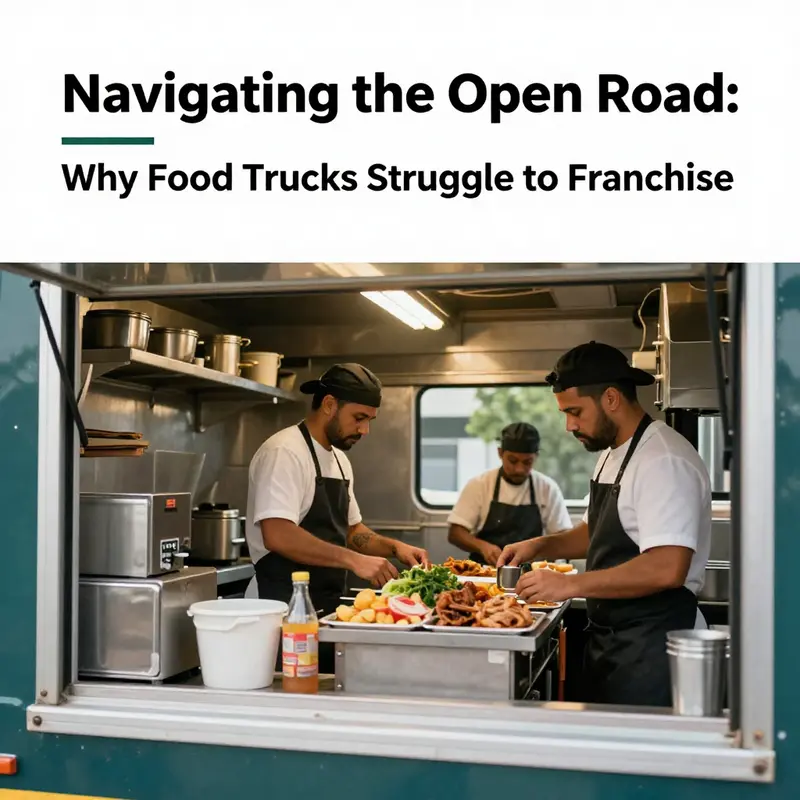
Mobility, lower upfront costs, and the brand promise of speed draw operators to food trucks. Yet the path to franchising rests on operational discipline that keeps quality and service consistent across markets. This chapter maps the threads that run through every scalable mobile concept: regulatory navigation, security, equipment reliability, design efficiency, and people systems.
Regulatory landscapes sit at the heart of the challenge: permits, health inspections, and zoning vary across jurisdictions. A franchisor must anticipate friction in forecasting, site strategy, and training, while regulators benefit from harmonization that reduces administrative drag.
Security and safety are inseparable from customer trust in a mobile kitchen: inventory controls, temperature management, cash handling, and standardized procedures protect both product and brand. Franchising amplifies these requirements, demanding uniform protocols that survive crowd pressure and deployment to new markets.
Mechanical reliability and smart design determine what can scale. Power solutions, efficient layouts, modular components, and durable equipment affect uptime, maintenance, and turnover. Space optimization and ergonomic workflows convert a truck into a repeatable production line.
Consistency hinges on codified training, clear recipes, and centralized supply governance. A franchise must translate tacit know-how into repeatable processes, with contingency plans for shortages and regional variation in ingredients.
People and leadership complete the system: recruiting, cross-training, performance metrics, and a culture of accountability ensure that a brand’s promise survives operator turnover and geographic dispersion.
When these elements come together, franchising a food truck becomes a deliberate scaling exercise rather than a leap of faith. The mobile advantage is preserved only if the backend system delivers same-day results across fleets, from Des Moines to downtown San Jose.
How Changing Tastes and Smart Tech Shape Food Truck Franchises
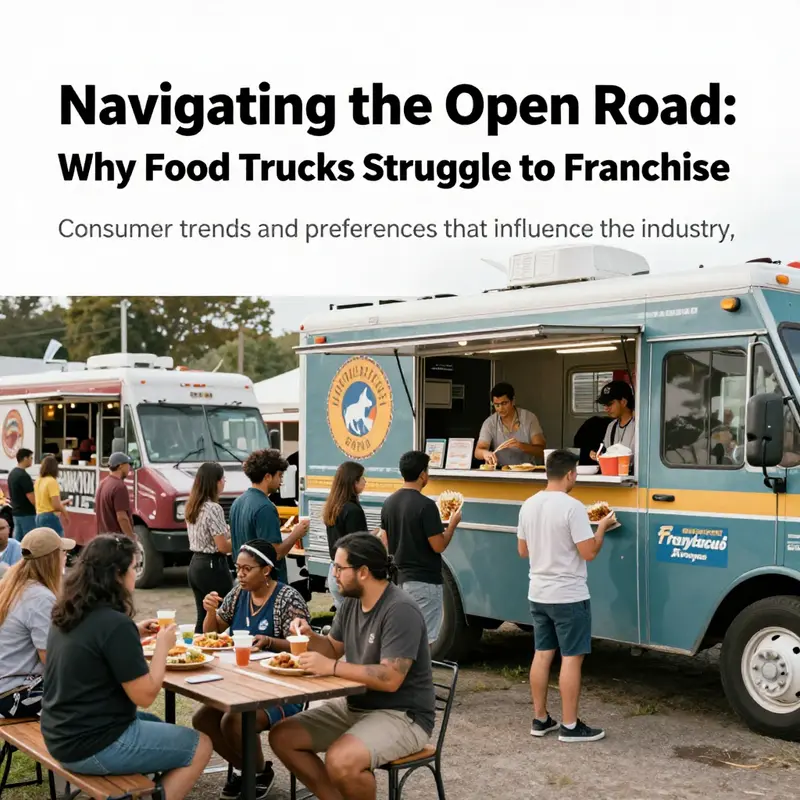
How consumer tastes, technology, and growth trends converge for food truck franchising
Consumer preferences now drive much of the momentum behind food truck franchising. Diners look for variety, authenticity, and value. They want meals that feel personal, not mass-produced. Food trucks satisfy this desire with focused menus, culturally specific offerings, and the ability to adapt quickly. This chapter explores how those preferences interact with market trends. It also explains what franchisors must prioritize to turn mobile concepts into reliable, scalable brands.
Menu variety is a core reason customers choose trucks over traditional fast food. Many operators succeed by specializing in a tight set of dishes executed at a high level. When a truck becomes known for one standout item, repeat visits increase. Customers appreciate depth over breadth: a few exceptional menu items trump a sprawling, mediocre lineup. That said, the market equally rewards creative fusion concepts and regional authenticity. Consumers seek new flavors and honest stories behind them. Cuisine-specific food trucks often build fast, passionate followings because they deliver a clear identity and memorable taste.
Price sensitivity remains a major factor, especially among younger diners. Millennials and Gen Z expect affordable options but will pay more for clear value. Value can mean larger portion sizes, premium ingredients, or ethical sourcing. Transparent communication about ingredients and practices often justifies a higher price point. Food truck brands that highlight fresh sourcing, sustainable packaging, and transparent safety practices find customers willing to spend a little extra. In many markets, trust in food safety profoundly influences purchasing decisions. Visible hygiene, certifications, and clear allergen information move casual buyers into loyal customers.
Urbanization and demographic patterns shape where trucks work best. Dense neighborhoods with concentrations of young professionals, students, and tourists create steady daytime and evening demand. Markets that favor mobile dining have high foot traffic and transient populations who value convenience. Franchisors must map these demographic trends carefully. Siting strategies that account for office densities, event calendars, and public transit hubs produce better unit economics than random street placement. Equally, franchises that allow local menu tweaks can capture neighborhood tastes without diluting the brand.
Technology now plays a central role in how consumers discover and interact with food trucks. Mobile ordering, contactless payments, and social engagement are no longer optional. Customers expect to pre-order, track wait times, and pay digitally. Built-in loyalty programs tied to apps encourage repeat visits and make it easier to collect useful customer data. Social media offers free amplification for standout trucks. Visual platforms reward strong photography and personality. Franchises that centralize digital marketing resources, yet let local operators keep a distinct voice, often scale faster. Digital tools also help coordinate inventory, schedule routes, and forecast demand, reducing waste and improving margins.
Market size and growth projections bolster the case for franchising. Industry forecasts estimate steady expansion over the next decade. This growth is driven by urban demand, event-based sales, and the continued appetite for novel dining experiences. For franchisors, growth numbers are an opportunity and a responsibility. They create room to refine training, standardize supply chains, and invest in technology that supports a dispersed fleet. But growth also intensifies competition, making differentiation crucial. Strong branding, consistent operations, and flexible localization become competitive advantages.
Brand consistency poses a unique challenge in a mobile model. A franchise system must define non-negotiable standards—food quality, safety protocols, packaging, and customer service—while allowing franchisees to adjust to local tastes. This balance requires clear operational playbooks and hands-on training. It also benefits from centralized procurement of key ingredients. Standardized components maintain quality across locations, while local produce and condiments let each unit feel rooted in its neighborhood. Franchisors who design modular menus gain traction. They provide a core menu and a set of region-specific options that franchisees may adopt.
Loyalty and visibility behave differently for trucks than for storefronts. Without a permanent address, trucks rely on consistent schedules and strong digital communication. Customers build loyalty through predictability—regular appearances at the same lunch spot, weekly event calendars, or reliable festival rotations. Trucks that cultivate a sense of occasion do well. They create experiences around food, not just transactions. Consistent visual branding, courteous service, and community engagement translate into repeat business. Word-of-mouth and user-generated content can drive rapid growth for standout concepts, but only when the on-truck experience matches the online promise.
Sustainability and social values increasingly influence decisions. Many consumers prefer brands aligned with environmental and ethical priorities. Franchises that reduce single-use plastics, prioritize local sourcing, and highlight waste reduction practices attract a conscientious clientele. These choices add cost but also deliver brand differentiation. They create stories that resonate on social platforms and in local press. For franchisors, sustainability can be an operational pillar. Consolidated buying and waste-management programs reduce per-unit costs while supporting marketing claims.
To capture these trends, franchisors must invest in scalable systems. Training that emphasizes both consistency and local adaptation produces better outcomes. Centralized supply chains lower ingredient costs and ensure quality. Digital platforms that handle ordering, loyalty, and route planning make operations predictable. Equally important is local empowerment. Franchise owners on the ground know their neighborhoods. Allowing them to suggest minor menu changes or event partnerships increases relevance while preserving brand integrity.
Finally, the evolving market creates opportunities for niche specialization. Trucks focused on health-forward versions of classic foods, ethnic street specialties, and seasonal menus find their audiences. For those interested in cuisine-specific strategies, there are clear examples to study. A useful resource on standout recipes and customer favorites is the collection of popular Latino food truck dishes, which shows how focused menus can build strong followings. popular Latino food truck dishes
Overall, consumer preferences and market trends favor food truck franchising when operators adapt thoughtfully. Success depends on blending mobility with consistent quality. It also requires digital fluency, demographic insight, and a willingness to standardize where it matters. With careful planning, a franchise model can harness variety, authenticity, and technology to scale a mobile dining brand across multiple markets. For detailed industry projections and market data, see the market research report here: https://www.mordorintelligence.com/industry-reports/food-truck-market
Final thoughts
The food truck industry stands at an intriguing intersection of opportunity and challenge. While the flexibility and appeal of mobile dining are undeniable, the road to franchising is fraught with regulatory, operational, and branding hurdles. For hobbyist car modifiers, professional car tuners, and enthusiasts alike, understanding these complexities can offer insights not only into the realm of food trucks but also into the broader dynamics of franchising in any mobile business context. As consumer preferences continue to evolve, those who navigate these waters successfully may unlock new avenues for entrepreneurial success.