
Food trucks are more than just mobile kitchens; they are thriving businesses with the potential for substantial profits. Understanding the intricate factors that contribute to their profitability is crucial for anyone looking to enter this dynamic market, especially car enthusiasts and modifiers who appreciate innovative adaptations in any realm. In this detailed exploration, we delve into three pivotal chapters that will illuminate the monthly profit ranges, revenue generation strategies, and essential startup costs associated with food trucks. Whether you’re considering launching your own or simply curious about the numbers, this guide will provide you with valuable insights.
From Sizzle to Bottom Line: Navigating Monthly Profit Realities for Food Trucks
Profit in the food truck world is as much about discipline as it is about flavor. The sizzling bustle of a busy street corner sets the stage, but the real calculus happens behind the scenes: how much revenue pours in, what keeps the costs tethered, and how consistently a truck can convert audience attention into actual earnings. The numbers that guide expectations are not universal law; they are a map drawn from location, cuisine, operating discipline, and seasonal rhythms. Still, they are a useful compass for anyone weighing the path from a colorful grill to a reliable monthly bottom line. In this chapter, we explore the typical trajectory of monthly profit for food trucks, the variables that push those numbers higher or lower, and the practical steps operators take to move the needle without losing the essence of their brand or the integrity of the operation.
A practical frame for profit begins with recognizing two broad truths. First, revenue in the mobile food sector tends to be robust in high-traffic settings—city centers, business districts, popular festival routes—where foot traffic and repeat customers intersect. Second, the profit story is mostly a function of costs: the price of ingredients, fuel, vehicle maintenance, insurance, permits, and staffing. When revenue climbs, margins can widen, but only if costs are managed with equal care. Across the industry, most operators report that monthly profit spans a wide spectrum. A common benchmark places net profit in roughly the $2,000 to $10,000 range per month for many trucks. Yet, the margin is not a fixed target; it expands or contracts with location, season, and how efficiently the business is run.
To ground this discussion in concrete terms, consider a few baseline realities. In many markets across the United States, a well-run food truck earns a monthly gross revenue that sits between about $25,000 and $50,000. This range reflects a blend of steady daily sales, peak weekend traffic, and opportunistic events. The net profit—the amount that remains after deducting variable costs such as food and supplies as well as fixed costs like the truck payment, insurance, and labor—tends to lie in the vicinity of 10% to 20% of gross revenue in a typical, well-managed operation. Put differently, a truck bringing in $40,000 in gross revenue each month might realize roughly $4,000 to $8,000 in profit after all expenses are accounted for. The broader pattern is that steady volume paired with disciplined cost control can yield a healthy bottom line, while missteps in either cost management or customer flow can shrink profits quickly.
However, this story has nuance that matters for planning. First, the location has a profound effect on profitability. High-traffic urban areas with a steady stream of office workers, commuters, and event-goers tend to produce larger, more consistent revenue streams. In such settings, even small differences in pricing, menu mix, or operating hours can translate into meaningful shifts in monthly profit. A truck operating in a major metropolis might consistently exceed the typical margins if it leverages a high-demand niche—think gourmet or specialty items that stand out in a crowded market, paired with an efficient operation that minimizes waste and optimizes labor. In practice, it is not unusual to see monthly profits above $15,000 in these premium locations when the model is right and demand remains strong.
In contrast, smaller towns or less populated regions tend to present stiffer profit challenges. Foot traffic may be slower, event opportunities less frequent, and the competitive landscape more intimate. In those markets, even a truck with strong execution can hover near the lower end of the profit spectrum, and in some early months the business may operate near break-even as it builds its customer base. Seasonality compounds these dynamics. Summer months often bring a surge of outdoor events, farmers markets, street fairs, and longer daylight hours that extend both the window for sales and the appetite for outdoor dining. Winter, in many locales, narrows those windows. In response, operators diversify, offering catering for private events, joining indoor markets, or repositioning the menu to attract a broader audience during the colder months.
The conversation about monthly profit must also reckon with the broader financial context of starting a food truck. Initial startup costs are not trivial. A used truck or chassis with a custom kitchen can require anywhere from roughly $50,000 to $115,000, depending on the vehicle’s condition, equipment needs, and whether branding and graphics are included. This capital outlay quickly colors early profitability because the debt service or depreciation associated with the loan or financing adds fixed costs that must be covered before real profits accumulate. The time to break even in the business is frequently cited as six to eighteen months, with location, execution, and market fit playing decisive roles in how quickly that milestone is reached.
Beyond the raw numbers, there is a quality of profit that comes with technique and strategy. Inventory management—keeping tight track of what moves, what doesn’t, and what ends up as waste—can meaningfully affect net margins. A well-practiced system for portioning, forecasting, and supplier negotiation reduces the variance in food costs from week to week. Food trucks thrive on speed and consistency; if a kitchen runs like a well-oiled machine, service tends to be faster, wait times shorten, and the ability to serve more customers without sacrificing quality improves. In turn, these operational efficiencies support healthier margins by increasing revenue per hour of operation while containing costs per unit sold.
A well-managed operation often relies on a combination of discipline and creativity. The discipline comes from a clear schedule, a predictable menu that matches the location, and a reliable supplier base that delivers consistent quality. The creativity shows up in the menu mix and the ways a truck persuades customers to try something new. A strategic menu—one that balances high-margin staples with crowd-pleasers—can lift impulse purchases and increase average ticket size. This is where a focused lever—such as featuring one or two signature items or rotating specialties tied to local events—can materially influence profitability over time. For many operators, the menu is not just about flavor; it is a carefully calibrated instrument for optimizing margins, cash flow, and customer retention.
To illustrate the financial range in a simple way, imagine a truck that generates $25,000 in gross revenue in a given month. If margins are in the traditional 10% to 20% band, net profit would typically fall between $2,500 and $5,000. In more aggressive cost-control environments or with a high-demand, high-margin menu, margins can approach 20% to 30%. In that case, the same $25,000 gross could translate into $5,000 to $7,500 in profit. A higher-end urban operation, where demand is consistently robust and the operator has built a loyal customer base and reliable catering stream, might even push toward or beyond the upper end of those margins, particularly if seasonality is favorable and events align with a strong product-market fit.
With this range in mind, a broader view emerges. The industrywide average monthly profit often lands between $2,000 and $10,000, a spread that reflects the diverse realities of the market. In the most active urban centers, profits can exceed $15,000, driven by volume, event-driven business, and the ability to monetize a well-chosen menu through quick service and repeat customers. The variability matters for anyone evaluating the model: a truck in the right place with the right offerings can outperform the mean, while one that lacks volume or is hampered by excessive costs can underperform the baseline expectations.
What does it take to navigate toward the higher end of the spectrum? First, market research and a clear understanding of the local appetite are essential. A truck should align its cuisine with real demand while avoiding direct, head-to-head competition against saturated offerings. Second, a smart route and scheduling strategy matters. Consistently choosing locations with predictable foot traffic, negotiating stable event calendars, and building relationships with organizers can create dependable daily throughput. Third, financial discipline matters as much as culinary skill. Strict inventory controls, accurate forecasting, and disciplined labor scheduling prevent costs from eating into margins. Fourth, branding and customer engagement cannot be forgotten. A memorable brand, reliable service, and a package of value-added interactions—like loyalty programs, mobile ordering, or catering partnerships—can transform occasional customers into regulars, a shift that compounds revenue and profit over time.
From a practical standpoint, many operators think in terms of linear math: more sales plus controlled costs equals higher profit multipliers. But in practice the math is rarely that simple because costs are not perfectly linear. Food costs behave like a function of volume, with bulk purchases and supplier terms providing some leverage as volumes rise. Labor costs, on the other hand, can scale with demand but must be carefully scheduled to avoid idle hours or overtime. Insurance, permits, and fixed vehicle costs are relatively constant, yet their impact grows when revenue is weak because they stretch a smaller revenue pool across the same set of fixed charges. This is why the savvy operator treats the business as an ongoing system—continuously adjusting pricing, menu mix, and labor allocation in response to real-time conditions, not just theoretical projections.
An often-overlooked factor is seasonality and diversification. Summer can be a springboard for profitability through outdoor events, craft markets, and office-district lunches that are lengthened by longer daylight. Winter, by contrast, compels creativity: shifting toward indoor markets, private catering for holidays or corporate events, or partnerships with venues that offer shelter and steady foot traffic. The most resilient operators diversify beyond street vending, layering in catering, pop-up collaborations, and even fixed-location concepts when feasible. This diversification can stabilize revenue streams and support more consistent profit, which is especially important when an operator is still building a brand, customer base, and event network.
The numbers, the disciplines, and the decisions all point toward a practical conclusion: there is meaningful profit in the food truck model, but it is earned through careful market positioning, tight cost controls, and a clear plan for scale. A strong profit story often shares a few common traits: a well-targeted menu with high-margin items, a location strategy that consistently yields foot traffic, and a culture of operational efficiency that minimizes waste and maximizes throughput. When these pieces align, the monthly profit can not only meet but exceed expectations.
The numbers also offer a cautionary note. Startups should be mindful of the break-even horizon. Even with a compelling product and a solid market, the business often requires six to eighteen months to reach steady profitability. During that period, cash flow and capital reserves matter as much as culinary skill. The road to profitability is rarely a straight line; it includes experiments with routes, menus, and even pricing. It also benefits from an openness to pivot when data show a persistent mismatch between what the market wants and what the truck delivers. This kind of adaptability is not a betrayal of a brand; it is a practical adaptation to how people choose to eat and where they choose to eat in different seasons.
Finally, it is worth acknowledging how profit intersects with broader business considerations. Financing decisions, such as loans or leases, carry interest costs that affect net margins. Insurance coverage ensures resilience against accidents and liabilities, but it also adds an ongoing expense that must be planned for. Permits, health inspections, and compliance costs vary by city and state, creating a patchwork of regulatory costs that can surprise the unprepared. Each of these factors—financing, insurance, permits, and compliance—plays a role in shaping the monthly profit, particularly for new entrants who are still optimizing their operating model and working to build a consistent customer base.
As you close this chapter on monthly profit ranges, the overarching message remains clear: profitability in the food truck sector is achievable and is frequently within reach for operators who combine a strong product with disciplined operations and adaptive market strategies. The range of potential profit—roughly $2,000 to $10,000 on average, with memorable outliers in high-demand markets—reflects a landscape where opportunity is real, but it is not guaranteed. The path to profitability requires a thoughtful blend of market insight, financial discipline, and operational agility. By focusing on high-demand locations, optimizing the menu for margin, controlling waste, and building a reliable schedule and event pipeline, a food truck can translate a lively, flavorful concept into a sustainable monthly bottom line. The chapter that follows will delve into how entrepreneurs translate these numbers into actionable business plans, including how to structure pricing, forecast cash flow, and design the kind of growth trajectory that makes the short-term profits add up to long-term resilience.
For readers interested in how menu choices impact profitability and market fit, a closer look at high-traffic, Latino-inspired offerings can provide practical lessons on balancing taste with margin. See the discussion on Top Latino Food Truck Dishes for ideas on menu items that tend to attract steady crowds while keeping costs in check: Top Latino Food Truck Dishes.
External research that informs these figures emphasizes the broader industry context and the seasonal dynamics that shape profitability over time. For a deeper dive into national trends, visit the National Restaurant Association’s insights on food truck trends and profitability, which highlight how events, demographics, and urban density influence demand and margins: https://www.nationalrestaurantassociation.com/industry-research/food-truck-trends-and-insights
On the Road to Profit: Reading Revenue, Margins, and the Real Conditions Behind Food Truck Profits
Profit in the food truck world looks simple at first glance: sell good food, manage costs, and watch the numbers add up. Yet the reality is more nuanced. Profitability hinges on a tapestry of moving parts that shift with location, season, customer taste, and the operator’s discipline. The core math is straightforward: gross revenue minus total costs equals net profit, and the size of that net profit depends on both the top line and how tightly you control expenses. When analyzed across many markets and operators, the picture becomes clearer: a well-run food truck in a high-traffic location can generate meaningful monthly profits after expenses, while trucks operating in less favorable conditions or with weak control of costs may struggle to reach even modest targets. The data points you’ll see stitched together here come from industry summaries, with both broad benchmarks and specific case examples to illuminate what is realistically possible and where the risks lie.
To begin, consider the typical range of monthly revenue and the expected margins. Industry summaries commonly place monthly gross sales for a food truck in a broad corridor around twenty-five thousand to fifty thousand dollars. From there, the business must absorb a constellation of costs: food and supplies (the cost of goods sold), fuel, maintenance, truck payments if financed, insurance, permits and inspections, payroll if there are crew members, and the variable costs tied to events and daily operations. Net profit margins—how much of gross revenue actually remains after all costs—tend to sit in a practical band of roughly 10% to 20% for many operators. A truck pulling in forty thousand dollars in a month might therefore clear four to eight thousand dollars in profit after every foot of expense has been accounted for. In other words, the same revenue profile can yield very different outcomes depending on how well costs are managed and how consistently sales are generated.
This margin framework translates into tangible numbers for a typical operator. If a truck earns around forty thousand dollars in a month, a conservative 10% margin would yield about four thousand dollars in net profit. A more efficient operation with robust demand, stronger inventory discipline, and streamlined labor could push that figure toward eight thousand dollars or more. High-demand locations—city centers, office districts during lunch, near large event venues—often push sales and can improve margins further, especially when the operator has an eye on speed, accuracy, and upsell opportunities. What looks like a comfortable margin on paper depends on how effectively the business converts foot traffic into repeat customers, uses data to forecast demand, and keeps waste and spoilage to a minimum.
Startup costs, however, are a meaningful counterweight to ongoing profitability. The up-front outlay required to launch a food truck operation typically ranges from fifty thousand to perhaps a hundred and fifteen thousand dollars when you include a used truck or a chassis with a customized kitchen. This initial investment matters because it affects how quickly you can break even. If startup costs are on the higher end, the time to recoup those investments lengthens, and the pressure on cash flow during the ramp-up years increases. In many cases, operators report a breaking-even horizon spanning six to eighteen months, depending on how aggressively they market, how efficiently they operate, and how favorable the location and market conditions prove to be.
A useful frame to hold in mind is that profit is a function of both top-line strength and cost discipline. On the top line, the emphasis tends to fall on location strategy, menu design, and price realization. The bottom line, meanwhile, rewards suppliers who negotiate favorable terms, minimize waste, and optimize labor. The more a truck can diversify revenue streams—through catering gigs, pop-up collaborations, or festival participation—the less exposure there is to a single source of revenue. Yet diversification itself comes with costs: additional staff, more inventory, and the logistics of moving between venues. A seasoned operator will weigh these factors with a careful eye on net margins, not just gross sales.
Location is perhaps the single most influential factor shaping profitability. High-traffic zones that convert passersby into paying customers can lift daily revenue by a factor that roughly doubles a truck’s sales in a less active setting. A downtown lunch corridor, a university campus, a hospital complex, or a large office park can become reliable engines of daily volume. But with high volume comes the need for sharp execution: fast service, consistent quality, and the ability to scale operations during peak windows. The pricing strategy must reflect the value delivered while staying aligned with what nearby customers are willing to pay. If the menu is designed to maximize margin, the operator can often absorb occasional slippage in foot traffic without materially shrinking net profit, provided waste is kept under control and labor is calibrated to the schedule.
Menu design matters as a profitability lever. Costs of ingredients are, of course, a core input, but so too are the margins on each item and the speed with which the kitchen can deliver. High-margin items—drinks, specialty toppings, premium proteins offered in limited quantities—can significantly tilt the overall margin if they perform well. Craft beverages or dessert items can carry disproportionate profitability relative to their complexity, especially when they benefit from strong branding and repeat customers who crave a signature experience. Conversely, menu items with razor-thin margins can erode overall profitability even if they attract high volume. The art here is balancing a compelling lineup with a margin-friendly pricing architecture that captures value without pricing out the target customer segment.
Cost management is the other half of the profitability equation. Fixed costs—truck loan payments, insurance, permits, and scheduled maintenance—must be covered regardless of daily sales. Variable costs—food ingredients, disposables, fuel, and hourly labor—scale with activity. The most resilient profit stories tend to be those that reduce waste through precise inventory controls and forecasting, negotiate bulk purchasing where feasible, and optimize staffing to match the day’s demand. For example, a truck that pre-plans menus around forecasted events can reduce last-minute ordering costs and avoid overstocking perishables. Efficient inventory management is often the most straightforward path to protecting margins, especially in markets with seasonal swings or unpredictable weather patterns that can depress foot traffic without warning.
Another layer in profitability is the role of labor. In many markets, labor is the second-largest cost after cost of goods sold. Good scheduling, cross-trained staff, and compact, efficient workflows can keep payroll from eroding margins. Operators who leverage seasonal peaks with part-time help and ensure that every hour of labor is purposeful tend to sustain healthier margins. This is not simply about reducing headcount; it’s about the right people in the right roles during the right windows, so the line moves quickly and consistently. The best teams also invest in training that speeds service and improves order accuracy, because even a few seconds shaved off a line and a few misfilled orders can accumulate into meaningful cost savings over a busy weekend.
The regulatory and permitting framework adds another dimension to profitability. Startups must allocate funds for licenses, health inspections, and general compliance. These costs can vary widely by city and state, and they can affect the cash flow trajectory of the first year. In some markets, permit renewals and annual insurance premiums become predictable line items, while in others the costs may spike during festivals or when expanding into new jurisdictions. A prudent operator builds a conservative budget that accounts for these recurring obligations and ensures that a portion of revenues is reserved for compliance-related expenses. The careful leader also keeps an eye on the long tail of compliance, recognizing that a lapse can be far costlier than the renewal itself by triggering fines, forced temporary closures, or reputational damage that hurts future sales.
There is also a strategic play in how the truck engages with the market beyond immediate sales. A well-executed branding and customer experience plan transforms occasional customers into repeat buyers and loyal advocates. This typically includes a strong social media presence, a simple and reliable ordering process, and thoughtful engagement with the local community. Event participation, for instance, can be both a source of revenue and a powerful marketing channel, reinforcing the brand and expanding the customer base. Yet events demand preparation: a predictable staffing plan, adequate inventory, and the capacity to scale service during peak windows. Operators who master the rhythm of events—knowing when to push specials, how to manage queues, and how to maintain quality under pressure—often see not only higher revenue on event days but also valuable long-term benefits through exposure and word-of-mouth referrals.
The chapter of profitability does not end with a formula. It is an ongoing discipline that blends practical finance with experiential intelligence. For an operator who starts with a clear understanding of the numbers, the path toward robust margins becomes an iterative process. Monitor sales by location and time, not just by day. Track item-level margins and the contribution of beverages or desserts to the bottom line. Use inventory data to guide purchasing and waste reduction. Build a lean staffing model that can stretch during slower hours and expand when demand surges. And maintain a robust plan for capital reinvestment. Some operators use incremental upgrades—better equipment, upgraded signage, a more efficient generator—to slowly but sustainably lift margins over time. Others pursue a more aggressive expansion strategy, growing into multiple trucks or diversifying into catering and private events, which can multiply both revenue streams and the complexity of operations.
The broader industry data helps anchor expectations. For example, broader market surveys note annual revenue ranges for food trucks that lie between roughly two hundred thousand and four hundred thousand dollars. Profit margins in the ten to fifteen percent ballpark are commonly cited as typical, with shorter horizons where margins surpass twenty percent for top operators in high-demand urban environments or during peak event periods. These figures are not guarantees. They reflect the range operators encounter across a wide spectrum of markets, from secondary cities to thriving downtown cores. They also point to a broader truth: profitability is less about a single number and more about the consistency of execution across months and seasons. The most resilient trucks are those that treat margins as a living target—regularly revisiting pricing, inventory turns, and staffing to ensure the enterprise remains buoyant under changing conditions.
In this context, a practical path for new entrants is to start with a realistic plan that maps revenue targets to cost structures and a timeline for break-even. A disciplined forecast might estimate monthly revenue, then separate fixed costs from variable costs to reveal what must be earned to reach a target profit. For many operators, success hinges on turning occasional busy days into reliable weekly patterns and using data to forecast demand. The discipline of reviewing daily sales, waste, and labor data becomes a habit that slowly compounds into steady margins. There is no one-size-fits-all blueprint; success comes from tailoring a model to the local market, the cuisine, and the operator’s capacity to execute efficiently while maintaining the integrity of the guest experience.
As a practical takeaway, consider that the most durable profitability strategies do not rely solely on chasing high volume. They hinge on a balanced recipe: attractive price realization, a menu with clearly defined margins, controlled costs, and a customer experience that repeatedly turns first-timers into steady patrons. When operators combine these elements with careful site selection, disciplined inventory management, and a readiness to adapt to the rhythm of festivals and office hours alike, the profit potential expands beyond a narrow band. The road to profit is then less a single milestone and more a cadence of improvements, tested in the real world and reinforced by data.
From Startup Budgets to Break-even Reality: Reading the Numbers That Decide a Food Truck’s Profit
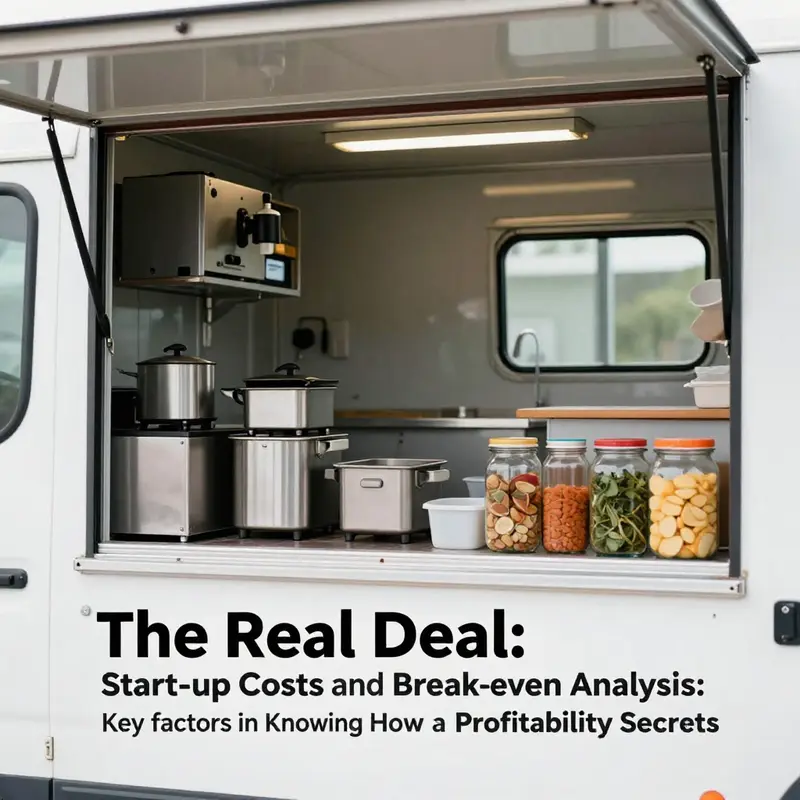
Profit on a food truck is not a whisper of luck or a lucky location; it is a conversation with several moving parts that must align over time. The numbers that define startup costs, operating expenses, revenue streams, and seasonality are the backbone of any credible forecast. When you step into the business, you are not merely buying a kitchen on wheels; you are committing to an ongoing discipline of pricing, purchasing, scheduling, and sales cultivation that determines whether the venture earns a living wage, a modest surplus, or nothing at all in its early chapters. In practice, profitability varies widely, but the roadmap is clear: revenue must cover fixed costs and variable costs, with enough left over to repay initial investments and sustain growth. In many high-traffic markets, a well-run truck can generate monthly profits that look substantial on paper and real in bank accounts—roughly in the range of a few thousand dollars to more than ten thousand dollars after every expense is accounted for. Yet this outcome relies on a chain of decisions that begins long before the first customer places an order, with the big-ticket upfront costs and a break-even point that can shape the entire trajectory of the business. The numbers tell the story before a single dish leaves the kitchen. They illuminate not just whether a truck can profit, but how to profit more consistently and with less risk over time. The conversation begins with the startup phase, where the price of getting up and running already carries a long tail of consequences. Upfront investments set the foundation for everything that follows. A vehicle becomes a kitchen, and a kitchen becomes a business, but nothing about that evolution is free. Vehicle purchases or leases, kitchen equipment, permits and licenses, insurance, initial inventory, and branding all squeeze into the first balance sheet. The National Restaurant Association offers a benchmark that many operators use to calibrate expectations: the average startup cost for a food truck typically lands in a broad band around fifty thousand to one hundred thousand dollars, though there are cases where high-end operations push well beyond that range. Those numbers matter because they establish the ceiling for early capitalization and influence how quickly a truck can reach profitability. If you are financing the project with a loan or lines of credit, every payment adds a fixed obligation that must be absorbed alongside the normal operating costs. If you’re driving a used chassis, you may trim upfront costs, but you trade off the reliability and efficiency that can translate into lower maintenance and fuel expenses over time. The tradeoffs are real, and they ripple through every quarterly forecast and monthly cash flow analysis.
The monthly reality of a food truck’s finances is equally instructive. Industry data and practitioner insights converge on a familiar picture: most trucks generate between twenty-five thousand and fifty thousand dollars in gross monthly revenue. From that gross, the net profit after deducting variable costs—food, packaging, and other costs tied to each sale—and the fixed costs that do not fluctuate with volume—truck payments, insurance, parking, labor, and ongoing marketing—tends to sit in a healthy band of roughly ten to twenty percent. In practical terms, a truck pulling forty thousand dollars in monthly sales might realize four thousand to eight thousand dollars in net profit after all costs, depending on the mix of location, events, and efficiency. The same logic helps explain why some operators routinely perform better in city centers, corporate campuses, or festival circuits where traffic is predictable and demand is strong. The calculus is not purely about volume; it is about the efficiency of every dollar spent and every dollar earned. Effective inventory management—reducing waste, anticipating popular items, and negotiating favorable supplier terms—can lift margins, especially when paired with a menu that balances high-margin items with crowd-pleasers that maintain high volume. A well-crafted menu that anchors the brand and aligns with the audience in a given locale can push a business from break-even to meaningful profitability, even if the headline revenue remains within the same band. The numbers thus become both compass and engine: compass for where to operate and how to price, engine for turning sales into sustainable profit. The narrative of how money flows through a food truck is reinforced by the start-up costs that shape early performance and by the break-even framework that translates in the clearest way what it takes to live on the business. Consider the upfront investment as a capital marathon rather than a sprint. When the venture is financed with a loan or lease on the truck, fixed monthly costs include payments that must be met regardless of sales. Insurance protects against the unknown, but it also adds a steady line item to the cash outflow. Permits and licenses are not a one-time hurdle; they often require renewal and ongoing compliance costs, which can be higher in some jurisdictions than others. These items do not vanish with a few strong weeks of sales; they persist. The initial inventory becomes the springboard for the first few weeks of operation, and the branding—signage, uniforms, a consistent truck wrap, even the packaging—helps shape customer perception and repeat business. In short, the startup phase is a testing ground for whether the plan can sustain the business through the inevitable early fluctuations in demand and the slower ramp-up that tends to accompany any new venture.
To ground this discussion in practical terms, it helps to anchor the conversation to break-even analysis—a tool that turns a collection of estimates into a concrete target. At its core, break-even analysis asks: what level of revenue is necessary for total revenue to equal total costs? In a food truck, you split costs into fixed costs—expenses that stay essentially the same month to month whether you sell one taco or a thousand—and variable costs—expenses that rise and fall with sales volume. A familiar, if simplified, example can illuminate the logic. Suppose fixed costs run about eight thousand dollars per month. Suppose the contribution margin per meal—the price you charge minus the variable cost of producing that meal—is roughly five dollars. With those assumptions, you would need to sell about one thousand six hundred meals per month to cover fixed costs (eight thousand dollars divided by five dollars per meal). If the truck operates at a vigorous pace—say during lunch hours in business districts, at popular events, and in areas with heavy foot traffic—you might surpass that threshold comfortably. If, however, your location yields lower foot traffic or if your variable costs creep higher, you could be left with a lean margin or a shortfall to cover the fixed payments and the other ongoing expenses. The same framework scales with different inputs. If your fixed costs are higher, or if your margin per meal is smaller due to pricing pressure, you will need more meals to break even. Conversely, aggressive pricing around a premium product or a sharp focus on high-volume items can raise the contribution margin, lowering the break-even requirement. The power of break-even analysis lies not in a single number but in the ability to stress-test different scenarios—different locations, different menus, different schedules—before committing to a path that could become costly if the reality diverges from the forecast.
The numbers do not exist in a vacuum; they interact with real-world conditions that govern profitability in the long run. High-demand locations—city centers, corporate campuses, and festival circuits—offer greater sales potential and, when managed well, improved margins. These are not guarantees; they come with demands: higher competition, more stringent permit rules, more intensive labor needs, and often more aggressive marketing and branding requirements. Yet the payoff can be meaningful. In markets where events are frequent and predictable, a truck can sustain a steady revenue stream that, after costs, translates into a stronger weekly paycheck for the operator and the team. The challenge remains how to scale that profitability without sacrificing quality or customer experience. A well-run truck is as much about process as it is about recipe. Inventory management, forecasting, and supplier relationships can shave cost per unit and reduce waste, while strategic staffing ensures that labor costs stay aligned with demand without compromising service speed. A crucial piece of this is the discipline to price thoughtfully and monitor the menu mix. A lean menu—focused on a core set of items that travel well, maintain consistency, and offer robust margins—usually produces steadier margins than a sprawling menu that inflates ingredient costs and complicates kitchen workflows. The best operators treat pricing as an ongoing conversation with customers, balancing value with margin, and adjusting for seasonality or event opportunities. The result is not a single moment of profit but a sequence of concerted decisions that cumulatively push the business toward sustainable profitability.
Although the arithmetic can be guided, the reality of break-even remains tempered by the entrepreneur’s management approach and the surrounding ecosystem. The start-up phase often requires a longer runway than expected because the upfront costs must be amortized against a period of ramping sales and building a customer base. The United States SBA resources—especially those tailored to food truck ventures—offer structured tools and templates that help new owners estimate costs, forecast sales, and determine how long it may take to reach profitability. The guidance emphasizes that local conditions—permitting timelines, parking policies, insurance premiums, and fuel costs—can dramatically sway the financial picture. In practice, even this robust planning still leaves room for variability, which is why ongoing monitoring is essential. Regularly revisiting the break-even calculation as actual results come in is an indispensable habit. If a month underperforms, you need to understand why: Was it a lower turnout, a pricing mismatch, a higher-than-expected fuel bill, or a scheduling error that reduced peak-hour sales? If a month overperforms, you want to capture those synergies—perhaps a popular event, or more efficient restocking—that can be replicated in subsequent cycles.
The long arc of profitability, then, depends on the careful balancing act of several streams: the upfront investment’s amortization, the consistency and predictability of revenue, and the discipline to manage costs with a steady eye on the bottom line. Initial capitalization matters because it determines how long the business may operate under pressure before hitting a comfortable cushion. An undercapitalized truck may be forced to trim critical expenses like maintenance or fail to invest in essential marketing and branding at a time when growth is most needed. By contrast, a well-capitalized operation can weather early volatility, invest in staff training, and participate in higher-margin events that accelerate the path to break-even and beyond. The reality is that most profitable food trucks are not simply clever cooks; they are teams that have learned to choreograph cash flow. They price, purchase, prepare, and serve with a pattern that minimizes waste and maximizes turnover, while maintaining high standards that build repeat visits and strong word-of-mouth referrals. They know, intimately, the levers of value: the ticket size that customers are willing to pay, the speed with which food is served, the energy costs and fuel efficiency of the truck, and the costs of compliance and risk management that keep the venture protected and capable of scaling.
As you consider the interplay of these factors, a few practical anchors emerge. First, expect a significant upfront investment, typically in the fifty- to one-hundred-thousand-dollar range for a well-equipped truck, with higher figures for more elaborate setups or new chassis. Second, anticipate a range of monthly revenue that commonly lands between twenty-five and fifty thousand dollars. Third, plan for a net margin that often lands between ten and twenty percent, recognizing that the higher end usually accompanies careful cost control, favorable locations, and a menu that supports high-volume, high-margin items. Finally, accept that the break-even point is not a single line but a set of thresholds that shift with pricing, volume, and cost structure. A practical approach is to compute break-even in terms of both units and dollars, so you know both how many meals to sell and what revenue that implies under your chosen pricing and cost assumptions. For example, with fixed monthly costs of eight thousand dollars and a five-dollar contribution margin per meal, you would need about one thousand six hundred meals per month to break even. Multiply by an average ticket of twelve dollars and the break-even revenue becomes nineteen thousand two hundred dollars a month. In a market that supports higher prices or greater efficiency, that break-even revenue could be lower, while a tougher market or higher fixed costs could push it higher. The exact numbers depend on your locale, your concept, and your operational discipline, but the principle remains consistent: profitability is the outcome of disciplined planning, disciplined operations, and a consistent effort to convert traffic into sustainable sales.
The final piece in this narrative is the human dimension—the team, the timing, and the resilience to sustain effort through the long arc from launch to profitability. It is easy to underestimate how much the early months shape future profitability. The time required to break even—often six to eighteen months, depending on location and execution—has a direct impact on cash flow planning and investor or lender confidence. A slower ramp may require more aggressive marketing or events to maintain positive liquidity, while a faster ramp can enable earlier investments in capacity, such as adding staff or upgrading equipment to improve service speed and menu breadth. These decisions feed back into the numbers and either tighten or widen profit margins over successive quarters. The dynamic is all the more complex when you layer in seasonality, competition, and the broader economic climate, which can influence discretionary spending and the appetite for street food in various neighborhoods.
The route to profitability, therefore, is not a single trick but a steady application of good financial hygiene and strategic execution. It requires a clear-eyed assessment of startup costs, an honest appraisal of ongoing fixed and variable costs, and a robust plan for driving the top line through price discipline, menu optimization, and targeted events. It also requires a willingness to learn and adapt: to adjust the menu in response to customer preferences, to renegotiate supplier terms when volume grows, and to refine scheduling to align peak sales windows with the most favorable parking spots and foot traffic. In short, a profitable food truck is built on a foundation of solid numbers, yes, but those numbers only become meaningful when paired with disciplined operations, responsive leadership, and a deep understanding of the market in which the truck operates. The math gives you a target; the operating playbook turns that target into real, repeatable results. As with any small business, there is no substitute for careful budgeting at the outset and vigilant monitoring thereafter. The better you understand the full spectrum of costs and the more accurately you model the break-even point under different scenarios, the more resilient your venture will be when the inevitable shifts in demand occur.
For readers seeking a structured path to translate these insights into their own planning, consider consulting the resources offered by the U.S. Small Business Administration, which provide templates, case studies, and practical guidance tailored to food truck startups. This approach helps bridge the gap between theory and practice, ensuring that the break-even analysis evolves from a theoretical exercise into a reliable planning tool that informs financing decisions, site selection, and growth strategy. In the end, profitability answers to the ability to convert a plan into predictable performance, season after season, and location after location. The numbers do not lie, but they do demand honesty, discipline, and a willingness to adjust as markets and customer tastes shift. When you align your costs with a strategy that prioritizes efficient operations, high-turnover days, and a compelling value proposition, the path from startup costs to break-even to sustained profit becomes less a gamble and more a negotiated forecast that you can monitor, manage, and improve over time.
Internal link for further considerations: legal considerations for Latino food-truck startups.
External resource for deeper guidance on the setup and financial planning of food trucks: https://www.sba.gov/business-guide/starting-a-business/food-truck
Final thoughts
Understanding the profitability of a food truck involves more than just crunching numbers; it requires insight into market trends, operational efficiency, and strategic decision-making. From the potential monthly profits to essential revenue streams and hidden costs, each aspect plays a crucial role in the success of the business. For car enthusiasts, the principles of modification and performance improvement apply equally to food trucks—streamlining operations and improving offerings can lead to greater returns. Embracing these insights can empower aspiring food truck owners to navigate the landscape confidently.